🎯 Learning Path:
- Complete REL-ID Complete Activation & Login Flow Codelab
- Complete REL-ID Additional Device Activation Flow Codelab
- You are here → Forgot Password Flow Implementation
Welcome to the REL-ID Forgot Password codelab! This tutorial builds upon your existing MFA implementation to add secure password recovery capabilities using REL-ID SDK's verification challenge.
What You'll Build
In this codelab, you'll enhance your existing MFA application with:
- 🔐 Conditional Forgot Password UI: Smart display logic based on challenge mode and server configuration
- 📧 Verification Challenge Flow: OTP and email verification for secure password reset
- 🔄 Multi-Path Reset Workflows: Dynamic routing through LDA consent or direct password reset
- 🎛️ Event Chain Orchestration: Complete forgot password event sequence management
- 🛡️ Security Best Practices: Secure password recovery with proper validation
What You'll Learn
By completing this codelab, you'll master:
- Forgot Password API Integration: Implementing
forgotPassword()API with proper sync response handling - Conditional UI Logic: Display forgot password based on
challengeModeandENABLE_FORGOT_PASSWORDconfiguration - Verification Challenge Handling: Managing
getActivationCodeevents for OTP/email verification - Dynamic Post-Verification Flow: Navigate through LDA consent or direct password reset paths
- Complete Event Chain Management: Orchestrate forgot password → verification → reset → login sequences
- Production Security Patterns: Implement secure password recovery with comprehensive error handling
Prerequisites
Before starting this codelab, ensure you have:
- ✅ Completed REL-ID MFA Codelab - All MFA screens and flows must be fully implemented
- ✅ Completed REL-ID MFA Complete Activation & Login Flow Codelab and REL-ID Additional Device Activation Flow Codelab - All MFA screens and flows must be fully implemented
- ✅ Flutter Development Environment - Android Studio, Xcode, and Flutter SDK configured
- ✅ REL-ID SDK Integration - Latest SDK with forgot password support configured
- ✅ Dart Knowledge - Understanding of Dart classes and type safety patterns
- ✅ Server Configuration - REL-ID server with
ENABLE_FORGOT_PASSWORDcapability
Get the Code from GitHub
The code to get started can be found in a GitHub repository.
You can clone the repository using the following command:
git clone https://github.com/uniken-public/codelab-flutter.git
Navigate to the relid-MFA-forgot-password folder in the repository you cloned earlier
Codelab Architecture Overview
This codelab extends your MFA application with three core forgot password components:
- Enhanced VerifyPasswordScreen: Conditional forgot password link with proper challenge mode detection
- Forgot Password API Integration: Service layer implementation following established SDK patterns
- Event Chain Management: Complete forgot password event sequence handling with navigation coordination
Before implementing forgot password functionality, let's understand the key SDK events and APIs that power the password recovery workflow.
Forgot Password Event Flow
The password recovery process follows this event-driven pattern:
VerifyPasswordScreen (challengeMode=0 and ENABLE_FORGOT_PASSWORD=true) → forgotPassword() API → getActivationCode Event →
User Enters OTP → setActivationCode() API → getUserConsentForLDA/getPassword Event →
Password Reset Complete → onUserLoggedIn Event → Dashboard
Core Forgot Password Event Types
The REL-ID SDK triggers these main events during forgot password flow:
Event Type | Description | User Action Required |
Verification challenge triggered after forgotPassword() | User enters OTP/verification code | |
LDA setup required after verification (Path A) | User approves biometric authentication setup | |
Direct password reset required (Path B) | User creates new password with policy validation | |
Automatic login after successful password reset | System navigates to dashboard automatically |
Conditional Display Logic
Forgot password functionality requires specific conditions:
// Forgot password display conditions
challengeMode == 0 AND ENABLE_FORGOT_PASSWORD == "true"
Condition | Description | Display Forgot Password |
| Manual password entry mode | ✅ Required condition |
| Password creation mode | ❌ Not applicable |
| Server feature enabled | ✅ Required configuration |
| Server feature disabled | ❌ Hide forgot password link |
Forgot Password API Pattern
Add these Dart definitions to understand the forgot password API structure:
// lib/uniken/services/rdna_service.dart (forgot password addition)

/// Initiates forgot password flow for password reset
///
/// ## Parameters
/// - [userId]: Optional user ID for the forgot password flow
///
/// ## Returns
/// Future<RDNASyncResponse> that resolves with sync response structure
Future<RDNASyncResponse> forgotPassword([String? userId]) async {
  print('RdnaService - Initiating forgot password flow for userId: ${userId ?? "current user"}');

  final response = await _rdnaClient.forgotPassword(userId);

  if (response.error?.longErrorCode == 0) {
    print('RdnaService - ForgotPassword sync success, starting verification challenge');
    return response;
  } else {
    print('RdnaService - ForgotPassword sync error: ${response.error?.errorString}');
    throw response;
  }
}
Let's implement the forgot password API in your service layer following established REL-ID SDK patterns.
Enhance rdnaService.dart with Forgot Password
Add the forgot password method to your existing service implementation:
// lib/uniken/services/rdna_service.dart (addition to existing class)

/// Initiates forgot password flow for password reset
///
/// This method initiates the forgot password flow when challengeMode == 0 and ENABLE_FORGOT_PASSWORD is true.
/// It triggers a verification challenge followed by password reset process.
/// Can only be used on an active device and requires user verification.
///
/// ## See Also
/// https://developer.uniken.com/docs/forgot-password
///
/// ## Workflow
/// 1. User initiates forgot password
/// 2. SDK triggers verification challenge (e.g., activation code, email OTP)
/// 3. User completes challenge
/// 4. SDK validates challenge
/// 5. User sets new password
/// 6. SDK logs user in automatically
///
/// ## Response Validation Logic
/// 1. Check error.longErrorCode: 0 = success, > 0 = error
/// 2. Success typically starts verification challenge flow
/// 3. Error Code 170 = Feature not supported
/// 4. Async events will be handled by event listeners
///
/// ## Parameters
/// - [userId]: Optional user ID for the forgot password flow
///
/// ## Returns
/// Future<RDNASyncResponse> that resolves with sync response structure
Future<RDNASyncResponse> forgotPassword([String? userId]) async {
  print('RdnaService - Initiating forgot password flow for userId: ${userId ?? "current user"}');

  final response = await _rdnaClient.forgotPassword(userId);

  print('RdnaService - ForgotPassword sync response received');
  print('RdnaService - Sync response:');
  print('  Long Error Code: ${response.error?.longErrorCode}');
  print('  Short Error Code: ${response.error?.shortErrorCode}');

  return response;
}
Service Pattern Consistency
Notice how this implementation follows the exact pattern established by other service methods:
Pattern Element | Implementation Detail |
Async/Await | Uses Flutter's async/await for asynchronous operations |
Error Checking | Validates |
Logging Strategy | Comprehensive print statements for debugging |
Direct Return | Returns response directly - caller handles success/error |
Now let's enhance your VerifyPasswordScreen to display forgot password functionality conditionally based on challenge mode and server configuration.
Add Conditional Display Logic
Implement the logic to determine when forgot password should be available:
// lib/tutorial/screens/mfa/verify_password_screen.dart (additions)

/// Check if forgot password is enabled from challenge info
/// Show "Forgot Password" only when:
/// - challengeMode is 0 (manual password entry)
/// - ENABLE_FORGOT_PASSWORD is true
bool _isForgotPasswordEnabled() {
  if (widget.eventData?.challengeMode != 0) return false;

  // Check for ENABLE_FORGOT_PASSWORD in challenge info
  final challengeInfo = widget.eventData?.challengeResponse?.challengeInfo;
  if (challengeInfo != null) {
    final enableForgotPassword = challengeInfo.firstWhere(
      (info) => info.key == 'ENABLE_FORGOT_PASSWORD',
      orElse: () => RDNAChallengeInfo(key: '', value: 'false'),
    ).value;
    return enableForgotPassword?.toLowerCase() == 'true';
  }

  // Default to true for challengeMode 0 if configuration is not available
  // This maintains backward compatibility
  return true;
}
Add State Management for Forgot Password
Enhance your screen's state management to handle forgot password loading:
// lib/tutorial/screens/mfa/verify_password_screen.dart (state additions)

class _VerifyPasswordScreenState extends ConsumerState<VerifyPasswordScreen> {
  final _passwordController = TextEditingController();
  String? _error;
  bool _isSubmitting = false;
  bool _isForgotPasswordLoading = false;
  String? _userId;
  int? _attemptsLeft;

  /// Check if any operation is in progress
  bool _isAnyOperationInProgress() {
    return _isSubmitting || _isForgotPasswordLoading;
  }
}
Implement Forgot Password Handler
Add the forgot password handling logic with proper error management:
// lib/tutorial/screens/mfa/verify_password_screen.dart (handler implementation)

/// Handle forgot password flow
Future<void> _handleForgotPassword() async {
  if (_isForgotPasswordLoading || _isSubmitting) return;

  setState(() {
    _isForgotPasswordLoading = true;
    _error = null;
    _validationMessage = null;
  });

  print('VerifyPasswordScreen - Initiating forgot password flow for userID: $_userId');

  final rdnaService = RdnaService.getInstance();
  final response = await rdnaService.forgotPassword(_userId);

  print('VerifyPasswordScreen - ForgotPassword sync response received');
  print('  Long Error Code: ${response.error?.longErrorCode}');
  print('  Short Error Code: ${response.error?.shortErrorCode}');

  if (response.error?.longErrorCode == 0) {
    // Success - SDK will handle async events (getActivationCode, getPassword, etc.)
    print('VerifyPasswordScreen - Forgot password initiated, waiting for async events');
    setState(() {
      _validationSuccess = true;
      _validationMessage = 'Password reset initiated successfully!';
      _isForgotPasswordLoading = false;
    });
  } else {
    setState(() {
      _error = response.error?.errorString ?? 'Failed to initiate forgot password';
      _isForgotPasswordLoading = false;
    });
  }
}
Add Conditional UI Rendering
Implement the forgot password link with proper loading states:
// Forgot Password Link - Only show when challengeMode == 0 and ENABLE_FORGOT_PASSWORD is true
if (_isForgotPasswordEnabled()) ...[
  const SizedBox(height: 16),
  if (_isForgotPasswordLoading)
    Row(
      mainAxisAlignment: MainAxisAlignment.center,
      children: const [
        SizedBox(
          width: 16,
          height: 16,
          child: CircularProgressIndicator(
            strokeWidth: 2,
            valueColor: AlwaysStoppedAnimation<Color>(Color(0xFF3498db)),
          ),
        ),
        SizedBox(width: 12),
        Text(
          'Initiating password reset...',
          style: TextStyle(
            fontSize: 16,
            color: Color(0xFF3498db),
            fontWeight: FontWeight.w500,
          ),
        ),
      ],
    )
  else
    TextButton(
      onPressed: _isAnyOperationInProgress() ? null : _handleForgotPassword,
      child: Text(
        'Forgot Password?',
        style: TextStyle(
          fontSize: 16,
          color: _isAnyOperationInProgress()
              ? const Color(0xFFbdc3c7)
              : const Color(0xFF3498db),
          decoration: TextDecoration.underline,
          fontWeight: FontWeight.w500,
        ),
      ),
    ),
],
The forgot password flow involves a sequence of events that your event manager must handle properly. Let's ensure your event handling supports the complete flow.
Event Chain Overview
After calling forgotPassword(), the SDK triggers this event sequence:
// Complete forgot password event flow
forgotPassword() → getActivationCode → getUserConsentForLDA/getPassword → onUserLoggedIn
Verify Event Manager Configuration
Ensure your rdnaEventManager.dart has proper handlers for all forgot password events:
// lib/uniken/services/rdna_event_manager.dart (verify these handlers exist)

/// Handle activation code request (triggered after forgotPassword)
void setGetActivationCodeHandler(RDNAGetActivationCodeCallback? callback) {
  _getActivationCodeHandler = callback;
}

void _onGetActivationCode(dynamic activationCodeData) {
  final data = activationCodeData as RDNAGetActivationCode;
  print('EventManager - onGetActivationCode triggered for forgot password flow');

  if (_getActivationCodeHandler != null) {
    _getActivationCodeHandler!(data);
  }
}

/// Handle LDA consent request (one possible path after verification)
void setGetUserConsentForLDAHandler(RDNAGetUserConsentForLDACallback? callback) {
  _getUserConsentForLDAHandler = callback;
}

void _onGetUserConsentForLDA(dynamic ldaConsentData) {
  final data = ldaConsentData as RDNAGetUserConsentForLDA;
  print('EventManager - onGetUserConsentForLDA triggered in forgot password flow');

  if (_getUserConsentForLDAHandler != null) {
    _getUserConsentForLDAHandler!(data);
  }
}

/// Handle password reset request (alternative path after verification)
void setGetPasswordHandler(RDNAGetPasswordCallback? callback) {
  _getPasswordHandler = callback;
}

void _onGetPassword(dynamic passwordData) {
  final data = passwordData as RDNAGetPassword;
  print('EventManager - onGetPassword triggered in forgot password flow');
  print('  Challenge Mode: ${data.challengeMode}');

  if (_getPasswordHandler != null) {
    _getPasswordHandler!(data);
  }
}

/// Handle successful login (final step of forgot password flow)
void setUserLoggedInHandler(RDNAUserLoggedInCallback? callback) {
  _userLoggedInHandler = callback;
}

void _onUserLoggedIn(dynamic loggedInData) {
  final data = loggedInData as RDNAUserLoggedIn;
  print('EventManager - onUserLoggedIn triggered - forgot password flow complete');

  if (_userLoggedInHandler != null) {
    _userLoggedInHandler!(data);
  }
}
Ensure your navigation system properly handles the forgot password event chain with type-safe route management.
Enhance Navigation Routes
Update your navigation configuration to support forgot password parameters:
// lib/tutorial/navigation/app_router.dart (route enhancements)

final appRouter = GoRouter(
  initialLocation: '/',
  routes: [
    GoRoute(
      path: '/verify-password',
      name: 'verifyPasswordScreen',
      builder: (context, state) {
        final data = state.extra as RDNAGetPassword?;
        return VerifyPasswordScreen(eventData: data);
      },
    ),
    GoRoute(
      path: '/activation-code',
      name: 'activationCodeScreen',
      builder: (context, state) {
        final data = state.extra as RDNAGetActivationCode?;
        return ActivationCodeScreen(eventData: data);
      },
    ),
    GoRoute(
      path: '/set-password',
      name: 'setPasswordScreen',
      builder: (context, state) {
        final data = state.extra as RDNAGetPassword?;
        return SetPasswordScreen(eventData: data);
      },
    ),
    GoRoute(
      path: '/lda-consent',
      name: 'ldaConsentScreen',
      builder: (context, state) {
        final data = state.extra as RDNAGetUserConsentForLDA?;
        return UserLDAConsentScreen(eventData: data);
      },
    ),
    GoRoute(
      path: '/dashboard',
      name: 'dashboardScreen',
      builder: (context, state) {
        final data = state.extra as RDNAUserLoggedIn?;
        return DashboardScreen(eventData: data);
      },
    ),
  ],
);
SDK Event Provider Integration
Ensure proper event routing in your global SDK event provider:
// lib/uniken/providers/sdk_event_provider.dart

class _SDKEventProviderWidgetState extends ConsumerState<SDKEventProviderWidget> {
  @override
  void initState() {
    super.initState();
    _setupSDKEventHandlers();
  }

  void _setupSDKEventHandlers() {
    final rdnaService = RdnaService.getInstance();
    final eventManager = rdnaService.getEventManager();

    // Navigation handlers for forgot password event chain
    eventManager.setGetActivationCodeHandler(_handleGetActivationCode);
    eventManager.setGetPasswordHandler(_handleGetPassword);
    eventManager.setGetUserConsentForLDAHandler(_handleGetUserConsentForLDA);
    eventManager.setUserLoggedInHandler(_handleUserLoggedIn);
  }

  void _handleGetActivationCode(RDNAGetActivationCode data) {
    appRouter.goNamed('activationCodeScreen', extra: data);
  }

  void _handleGetPassword(RDNAGetPassword data) {
    // Route based on challengeMode
    if (data.challengeMode == 0) {
      appRouter.goNamed('verifyPasswordScreen', extra: data);
    } else {
      appRouter.goNamed('setPasswordScreen', extra: data);
    }
  }

  void _handleGetUserConsentForLDA(RDNAGetUserConsentForLDA data) {
    appRouter.goNamed('ldaConsentScreen', extra: data);
  }

  void _handleUserLoggedIn(RDNAUserLoggedIn data) {
    appRouter.goNamed('dashboardScreen', extra: data);
  }
}
Let's test your forgot password implementation with comprehensive scenarios to ensure proper functionality.
Test Scenario 1: Standard Forgot Password Flow
Setup Requirements:
- Server configuration:
ENABLE_FORGOT_PASSWORD = "true" - Navigation to VerifyPasswordScreen with
challengeMode = 0
Test Steps:
- Launch app and navigate to VerifyPasswordScreen
- Verify "Forgot Password?" link is visible
- Tap forgot password link
- Verify loading state displays: "Initiating password reset..."
- Complete OTP verification when ActivationCodeScreen appears
- Follow either LDA consent or password reset path
- Confirm automatic login to dashboard
Expected Results:
- ✅ Forgot password link appears conditionally
- ✅ Loading states provide clear user feedback
- ✅ Event chain completes successfully
- ✅ User reaches dashboard without manual navigation
Test Scenario 2: Forgot Password Disabled
Setup Requirements:
- Server configuration:
ENABLE_FORGOT_PASSWORD = "false"or missing - Navigation to VerifyPasswordScreen with
challengeMode = 0
Test Steps:
- Navigate to VerifyPasswordScreen
- Verify forgot password link is NOT visible
- Confirm only standard password verification is available
Expected Results:
- ❌ Forgot password link should not appear
- ✅ Standard password flow remains functional
Test Scenario 3: Wrong Challenge Mode
Setup Requirements:
- Navigation with
challengeMode = 1(password creation mode)
Test Steps:
- Navigate to VerifyPasswordScreen with challengeMode = 1
- Verify forgot password link is NOT visible
- Confirm only password creation flow is available
Expected Results:
- ❌ Forgot password link should not appear
- ✅ Password creation flow works normally
Run Tests with Flutter
# Run on connected device
flutter run

# Run with verbose logging
flutter run -v

# Run on specific device
flutter run -d <device-id>

# Hot reload during testing (press 'r' in terminal)
# Hot restart during testing (press 'R' in terminal)
Prepare your forgot password implementation for production deployment with these essential considerations.
Security Validation Checklist
- [ ] No Sensitive Data Logging: Verify no user credentials or verification codes are logged
- [ ] Rate Limiting Awareness: Handle verification attempt limits gracefully
- [ ] Session Management: Proper handling of session timeouts during password reset
- [ ] Input Validation: Validate all user inputs before sending to server
User Experience Optimization
- [ ] Clear Error Messages: User-friendly errors for all failure scenarios
- [ ] Consistent Loading States: Visual feedback during all async operations
- [ ] Accessibility Support: Screen reader compatibility and keyboard navigation
- [ ] Performance Testing: Validate performance with slow network conditions
- [ ] Background Handling: Proper app state management during password reset
Flutter-Specific Best Practices
- [ ] State Management: Use appropriate state management (Riverpod, Provider, Bloc)
- [ ] Widget Lifecycle: Proper dispose() cleanup for controllers and subscriptions
- [ ] Null Safety: Leverage Dart's null safety features
- [ ] Asynchronous Operations: Proper async/await and error handling
- [ ] Build Method Optimization: Minimize rebuilds with const constructors
Here's your complete reference implementation combining all the patterns and best practices covered in this codelab.
Enhanced VerifyPasswordScreen with Forgot Password
// lib/tutorial/screens/mfa/verify_password_screen.dart (complete implementation)

import 'package:flutter/material.dart';
import 'package:flutter_riverpod/flutter_riverpod.dart';
import 'package:rdna_client/rdna_struct.dart';
import '../../../uniken/services/rdna_service.dart';
import '../../../uniken/utils/rdna_event_utils.dart';
import '../components/custom_button.dart';
import '../components/custom_input.dart';
import '../components/status_banner.dart';
import '../components/close_button.dart';

class VerifyPasswordScreen extends ConsumerStatefulWidget {
  final RDNAGetPassword? eventData;

  const VerifyPasswordScreen({
    super.key,
    this.eventData,
  });

  @override
  ConsumerState<VerifyPasswordScreen> createState() =>
      _VerifyPasswordScreenState();
}

class _VerifyPasswordScreenState extends ConsumerState<VerifyPasswordScreen> {
  final _passwordController = TextEditingController();
  String? _error;
  bool _isSubmitting = false;
  bool _isForgotPasswordLoading = false;
  String? _validationMessage;
  bool _validationSuccess = false;
  bool _obscurePassword = true;
  String? _userId;
  int? _attemptsLeft;

  @override
  void initState() {
    super.initState();
    _processEventData();
  }

  @override
  void didUpdateWidget(VerifyPasswordScreen oldWidget) {
    super.didUpdateWidget(oldWidget);
    // Re-process when eventData changes (SDK re-triggers getPassword with error)
    if (widget.eventData != oldWidget.eventData) {
      print('VerifyPasswordScreen - Event data updated, re-processing');
      _processEventData();
    }
  }

  void _processEventData() {
    if (widget.eventData == null) return;

    final data = widget.eventData!;

    setState(() {
      _userId = data.userId;
      _attemptsLeft = data.attemptsLeft;
    });

    // Check for API errors first
    if (RDNAEventUtils.hasApiError(data.error)) {
      final errorMessage = RDNAEventUtils.getErrorMessage(data.error, null);
      setState(() {
        _error = errorMessage;
        _validationSuccess = false;
      });
      return;
    }

    // Check for status errors
    if (RDNAEventUtils.hasStatusError(data.challengeResponse?.status)) {
      final errorMessage = RDNAEventUtils.getErrorMessage(
          null, data.challengeResponse?.status);
      setState(() {
        _error = errorMessage;
        _validationSuccess = false;
      });
      return;
    }

    // Success - ready for password input
    setState(() {
      _validationSuccess = true;
      _validationMessage = 'Ready to verify password';
      _error = null;
    });
  }

  /// Check if forgot password is enabled from challenge info
  bool _isForgotPasswordEnabled() {
    if (widget.eventData?.challengeMode != 0) return false;

    final challengeInfo = widget.eventData?.challengeResponse?.challengeInfo;
    if (challengeInfo != null) {
      final enableForgotPassword = challengeInfo.firstWhere(
        (info) => info.key == 'ENABLE_FORGOT_PASSWORD',
        orElse: () => RDNAChallengeInfo(key: '', value: 'false'),
      ).value;
      return enableForgotPassword?.toLowerCase() == 'true';
    }

    return true;
  }

  /// Handle forgot password flow
  Future<void> _handleForgotPassword() async {
    if (_isForgotPasswordLoading || _isSubmitting) return;

    setState(() {
      _isForgotPasswordLoading = true;
      _error = null;
      _validationMessage = null;
    });

    final rdnaService = RdnaService.getInstance();
    final response = await rdnaService.forgotPassword(_userId);

    if (response.error?.longErrorCode == 0) {
      setState(() {
        _validationSuccess = true;
        _validationMessage = 'Password reset initiated successfully!';
        _isForgotPasswordLoading = false;
      });
    } else {
      setState(() {
        _error = response.error?.errorString ?? 'Failed to initiate forgot password';
        _isForgotPasswordLoading = false;
      });
    }
  }

  Future<void> _handleVerifyPassword() async {
    final password = _passwordController.text;

    setState(() {
      _isSubmitting = true;
      _error = null;
    });

    final rdnaService = RdnaService.getInstance();
    final response = await rdnaService.setPassword(
      password,
      RDNAChallengeOpMode.RDNA_CHALLENGE_OP_VERIFY,
    );

    if (response.error?.longErrorCode == 0) {
      setState(() {
        _validationSuccess = true;
        _isSubmitting = false;
      });
    } else {
      setState(() {
        _error = response.error?.errorString ?? 'Unknown error';
        _isSubmitting = false;
      });
    }
  }

  Future<void> _handleClose() async {
    final rdnaService = RdnaService.getInstance();
    await rdnaService.resetAuthState();
  }

  bool _isFormValid() {
    return _passwordController.text.isNotEmpty && _error == null;
  }

  bool _isAnyOperationInProgress() {
    return _isSubmitting || _isForgotPasswordLoading;
  }

  @override
  Widget build(BuildContext context) {
    return GestureDetector(
      onTap: () => FocusScope.of(context).unfocus(),
      child: Scaffold(
        backgroundColor: const Color(0xFFF8F9FA),
        body: SafeArea(
          child: Stack(
            children: [
              Padding(
                padding: const EdgeInsets.all(20),
                child: Column(
                  mainAxisAlignment: MainAxisAlignment.center,
                  children: [
                    const Text(
                      'Verify Password',
                      style: TextStyle(
                        fontSize: 28,
                        fontWeight: FontWeight.bold,
                        color: Color(0xFF2c3e50),
                      ),
                      textAlign: TextAlign.center,
                    ),
                    const SizedBox(height: 8),
                    const Text(
                      'Enter your password to continue',
                      style: TextStyle(
                        fontSize: 16,
                        color: Color(0xFF7f8c8d),
                      ),
                      textAlign: TextAlign.center,
                    ),
                    const SizedBox(height: 30),

                    if (_userId != null) ...[
                      const Text(
                        'Welcome back',
                        style: TextStyle(fontSize: 18, color: Color(0xFF2c3e50)),
                      ),
                      const SizedBox(height: 4),
                      Text(
                        _userId!,
                        style: const TextStyle(
                          fontSize: 20,
                          fontWeight: FontWeight.bold,
                          color: Color(0xFF3498db),
                        ),
                      ),
                      const SizedBox(height: 20),
                    ],

                    if (_attemptsLeft != null)
                      StatusBanner(
                        type: StatusBannerType.warning,
                        message: '$_attemptsLeft attempt${_attemptsLeft != 1 ? 's' : ''} remaining',
                      ),

                    if (_error != null)
                      StatusBanner(
                        type: StatusBannerType.error,
                        message: _error!,
                      ),

                    CustomInput(
                      label: 'Password',
                      value: _passwordController.text,
                      onChanged: (value) {
                        setState(() {
                          _passwordController.text = value;
                          if (_error != null) _error = null;
                        });
                      },
                      placeholder: 'Enter your password',
                      obscureText: _obscurePassword,
                      enabled: !_isAnyOperationInProgress(),
                      suffixIcon: IconButton(
                        icon: Icon(
                          _obscurePassword ? Icons.visibility : Icons.visibility_off,
                          color: const Color(0xFF7f8c8d),
                        ),
                        onPressed: () {
                          setState(() {
                            _obscurePassword = !_obscurePassword;
                          });
                        },
                      ),
                    ),

                    CustomButton(
                      title: _isSubmitting ? 'Verifying...' : 'Verify Password',
                      onPress: _handleVerifyPassword,
                      loading: _isSubmitting,
                      disabled: !_isFormValid() || _isAnyOperationInProgress(),
                    ),

                    // Forgot Password Link
                    if (_isForgotPasswordEnabled()) ...[
                      const SizedBox(height: 16),
                      if (_isForgotPasswordLoading)
                        Row(
                          mainAxisAlignment: MainAxisAlignment.center,
                          children: const [
                            SizedBox(
                              width: 16,
                              height: 16,
                              child: CircularProgressIndicator(
                                strokeWidth: 2,
                                valueColor: AlwaysStoppedAnimation<Color>(Color(0xFF3498db)),
                              ),
                            ),
                            SizedBox(width: 12),
                            Text(
                              'Initiating password reset...',
                              style: TextStyle(
                                fontSize: 16,
                                color: Color(0xFF3498db),
                                fontWeight: FontWeight.w500,
                              ),
                            ),
                          ],
                        )
                      else
                        TextButton(
                          onPressed: _isAnyOperationInProgress() ? null : _handleForgotPassword,
                          child: Text(
                            'Forgot Password?',
                            style: TextStyle(
                              fontSize: 16,
                              color: _isAnyOperationInProgress()
                                  ? const Color(0xFFbdc3c7)
                                  : const Color(0xFF3498db),
                              decoration: TextDecoration.underline,
                              fontWeight: FontWeight.w500,
                            ),
                          ),
                        ),
                    ],

                    const SizedBox(height: 20),
                    Container(
                      padding: const EdgeInsets.all(16),
                      decoration: BoxDecoration(
                        color: const Color(0xFFe8f4f8),
                        borderRadius: BorderRadius.circular(8),
                      ),
                      child: const Text(
                        'Enter your password to verify your identity and continue.',
                        style: TextStyle(
                          fontSize: 14,
                          color: Color(0xFF2c3e50),
                        ),
                        textAlign: TextAlign.center,
                      ),
                    ),
                  ],
                ),
              ),
              CustomCloseButton(
                onPressed: _handleClose,
                disabled: _isAnyOperationInProgress(),
              ),
            ],
          ),
        ),
      ),
    );
  }

  @override
  void dispose() {
    _passwordController.dispose();
    super.dispose();
  }
}
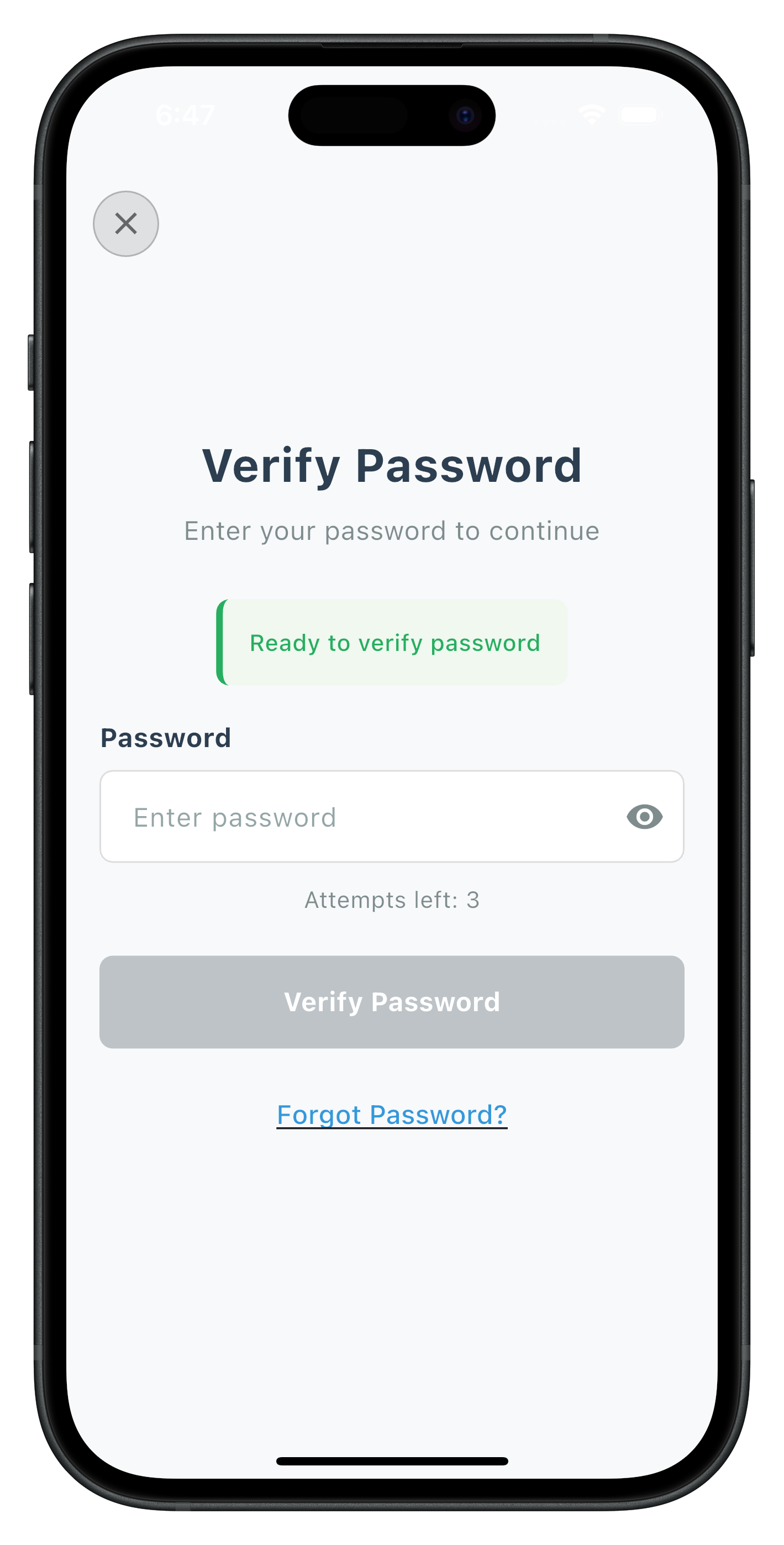
The following image showcases the screen from the sample application:
Congratulations! You've successfully implemented secure forgot password functionality with the REL-ID SDK.
🚀 What You've Accomplished
✅ Conditional Forgot Password UI - Smart display logic based on challenge mode and server configuration ✅ Secure API Integration - Proper forgotPassword() implementation with error handling ✅ Event Chain Management - Complete flow from verification to password reset to login ✅ Production-Ready Code - Comprehensive error handling, loading states, and security practices ✅ User Experience Excellence - Clear feedback, intuitive flow, and accessibility support
📚 Additional Resources
- REL-ID Developer Documentation - Complete API reference
- Flutter Security Best Practices - Platform security guidelines
- Dart Language Tour - Advanced Dart patterns
🔐 You've mastered secure password recovery with REL-ID SDK!
Your implementation provides users with a seamless, secure way to recover their accounts while maintaining the highest security standards. Use this foundation to build robust authentication experiences that users can trust.